
Section 504 – Celiac Disease Edition
As an Amazon Associate and member of other affiliate programs, I earn from qualifying purchases.
There are many laws that protect those with Celiac Disease. The Americans with Disabilities Act protects us. Because it’s a disability, it’s covered under Section 504. However, some states want to overturn Section 504. Here’s what you need to know.

Is Celiac Disease a Disability?
Some of us may not think of Celiac Disease as a disability. We don’t need to use wheelchairs. We don’t have cognitive impairments. However, in 2009 the government updated the Americans with Disabilities Acts to include major life functions such as “eating.”
It was this very act that requires colleges and universities to feed students with dietary restriction. In 2012, a lawsuit was brought against Lesley University. They were requiring students to pay for a meal plan, but refused to accommodate their dietary restrictions. Students won the lawsuit, because it violated the American Disabilities Act.
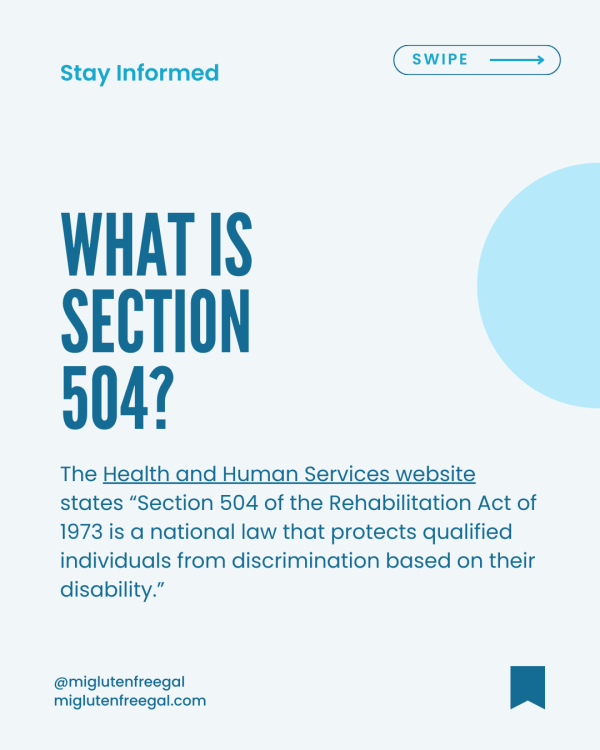
What is Section 504?
The Health and Human Services website states “Section 504 of the Rehabilitation Act of 1973 is a national law that protects qualified individuals from discrimination based on their disability.”
In full, it states “No otherwise qualified individual with a disability in the United States, as defined in section 705(20) of this title, shall, solely by reason of her or his disability, be excluded from the participation in, be denied the benefits of, or be subjected to discrimination under any program or activity receiving federal financial assistance or under any program or activity conducted by any Executive agency or by the United States Postal Service.”
How Does Section 504 Apply to People with Celiac Disease?
Section 504 most is most often applied to students with Celiac Disease who attend public school. Because public schools receive federal funding, students can’t be denied activities or benefits other students receive because of their gluten free diet.
Students with Celiac Disease are encouraged to have 504 plans, which are a legally binding document. 504 plans outline what accommodations the school will offer the student. It also outlines how parents will work with the school in meeting that 504 plan.
Examples of 504 Accommodations for Celiac Disease at School
The Gluten Intolerance Group wrote an article called “Gluten-Free Safety at School.” They list some possible accommodations, such as gluten free playdough and more:
- Gluten-free meal options for school-served meals.
- Access to a refrigerator, freezer, and microwave to store and prepare gluten-free meals.
- Gluten-free options at school activities that involve food, including parties and field trips. (These top 9 allergen free snacks would be good for this.)
- Ability to go to the bathroom without restrictions or limitations, as needed.
- Access to gluten-free school art supplies, particularly for younger children who might use certain play doughs, paints, glues, papier-mâché (wheat flour-based), and even dried pasta.
- Training for school staff about celiac disease and gluten sensitivity.
Examples of 504 Accommodations for Celiac Disease at Work
The website Special Education Journey states “Section 504 of the Rehabilitation Act of 1973 applies to employees and students and bans discrimination based on disability in any federally funded program or activity. It includes employers who get federal funding or participate in programs supported by the federal government, such as those described by the U.S. Department of Labor.
Section 504 requires companies to offer reasonable accommodations for disabled employees unless doing so would impose an undue hardship.” Accommodations for those with Celiac Disease may include:
- Gluten-free food options at company events
- Designated areas for eating gluten-free meals
- Flexible break times to manage symptoms
- The ability to bring personal snacks
- Training for colleagues on cross-contamination prevention
- The option to wash hands frequently without penalty when necessary.
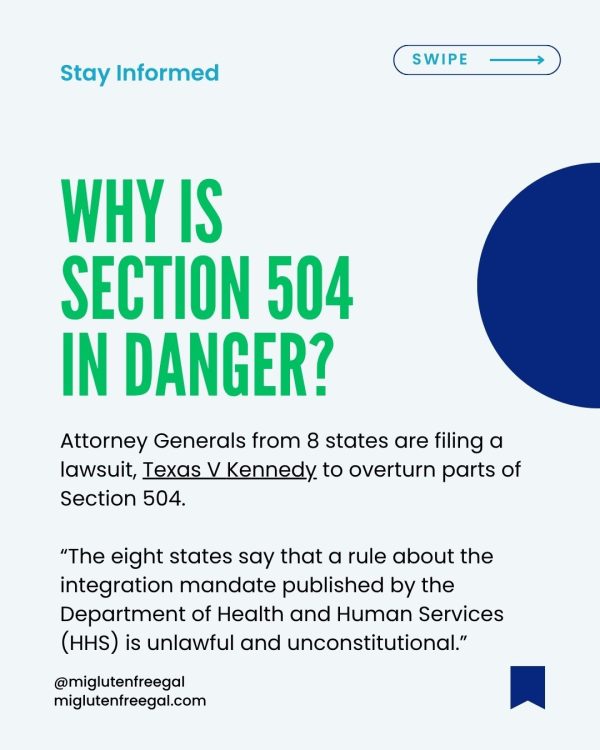
Why Is Section 504 in Danger?
Attorney Generals from 8 states are filing a lawsuit, Texas V Kennedy, (formerly Texas v Becerra) to overturn parts of Section 504. They cite that recent additions to Section 504 are problematic.
“On May 9, 2024 the Biden Administration finalized a new rule that upends decades of federal disability law by (1) obligating all recipients of federal financial assistance to provide services in “the most integrated setting,”
It allows people with disabilities to receive services in the community rather than in institutions. In 1999, the U.S. Supreme Court upheld this mandate in its landmark Olmstead v. L.C. decision.
DEMAND FOR RELIEF Plaintiffs respectfully request that the Court:
- a. Declare that the Final Rule violates the Administrative Procedure Act because it is unconstitutional, exceeds statutory authority and is contrary to law, and arbitrary and capricious;
- b. Hold unlawful and set aside (i.e., vacate) the Final Rule;
- c. Issue permanent injunctive relief against Defendants enjoining them from enforcing the Final Rule;
- d. Issue permanent injunctive relief against Defendants enjoining them from obligating Plaintiffs to alter their programs and activities to ensure the provision of services in “the most integrated setting” as defined in the Final Rule, and enjoining them from prohibiting Plaintiffs to engage in actions resulting in “serious risk of institutionalization” and from allowing claims of discrimination to be asserted even when no institutionalization or segregation has occurred;
- e. Award attorneys’ fees and costs incurred in this action to Plaintiffs;
- f. Issue any and all other relief to Plaintiffs the Court deems just and proper.
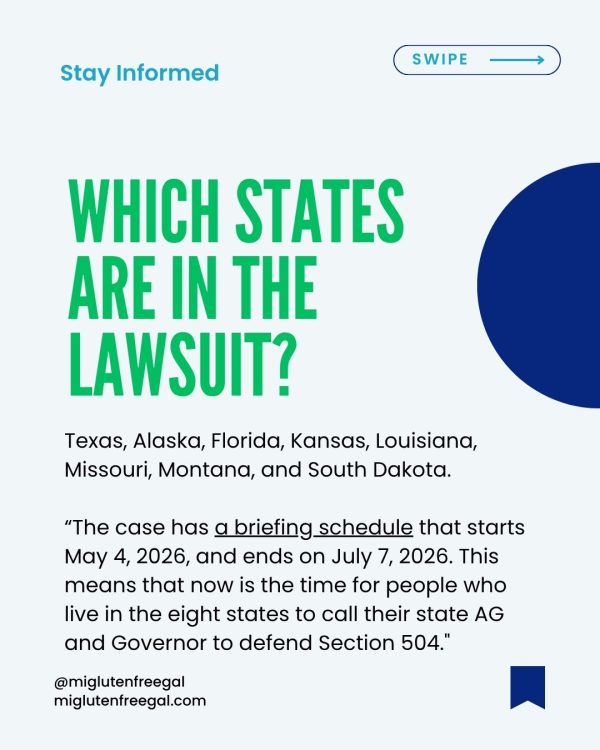
Which 8 State Attorneys Generals are Bringing This Lawsuit?
Below are the 8 states signed on to this lawsuit. Remember, if parts of Section 504 are overturned by these states, it will impact ALL states in the U.S.
- Alaska
- Florida
- Kansas
- Louisiana
- Missouri
- Montana
- South Dakota
- Texas
“The states asked the judge to decide the lawsuit without a trial. Over the next few months, the states and feds will file briefs with the court. Disability community groups and allies will have the chance to file briefs as well.
If the states prevail, it’s hard to say what the cascading legal impacts could be. A win could trigger further litigation. Other courts might interpret the law differently.” ~Stateline

What Can I Do To Help?
There are two things we can do to help this situation. The first is educating people on the topic. Disability Rights Education and Defense Fund (DREDF) has a great website loaded with information. Share it with those who would be impacted by losing protections under Section 504. Watch their webinar recording for more information.
Our second avenue for advocacy is to write to our attorney generals. What you ask them to do depends on what state that you live in. You can find your attorney general through the National Association of Attorneys General to find your AG. Each AG has a link to their website, where you can find their contact information.
For Those Who Live in The 8 States
If you live in one of the states brining this lawsuit, write to your attorney general and ask them to remove themselves from the lawsuit. You can call them, email them, or ask to speak with them publicly.
For Those who Live in Other States
For those who don’t live one of the 8 states, you can still write to your Attorney General. Ask them to write an amicus brief in support of Section 504. I suggest emailing your attorney general, and calling their office as well.
Why Do You Have to Be Political?
I know what some of you are thinking. Stay out of politics. But in America, health care is political. Given that Celiac Disease falls under the protection of the Americans with Disabilities Act, disability rights are political. And to be honest, I consider myself more than just a “blogger.” I’m an advocate, and that means standing up for you, for your kids, and for everyone who has Celiac Disease.
New to My Blog?
I share more about my personal life in the About section of my website. Learn more about me and my Celiac Disease diagnosis in this post. My most popular content is Michigan Gluten Free Restaurant Reviews, and I’m super proud to support gluten free bakers in Michigan.