
United States Gluten Free and Food Allergen Labeling Rules
As an Amazon Associate and member of other affiliate programs, I earn from qualifying purchases.
If you have Celiac Disease, food allergies, or any other dietary restriction, reading food labels is an important part of keeping yourself and your family safe. But do you know all the ins and outs and regulations? Read my blog post to learn more about gluten free and food allergen labeling rules in the United States.
Celiac Disease vs Food Allergies
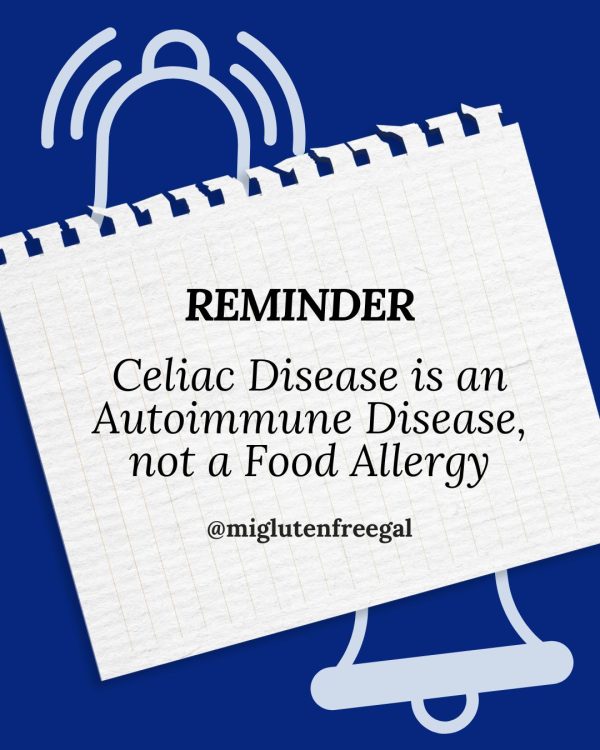
First, I’d like to state an important fact. Celiac Disease is NOT a food allergy. Celiac Disease is an autoimmune disease. While people with Celiac Disease and a Wheat Allergy both need to steer clear of wheat proteins, the biological reaction in the body is different.
In Celiac Disease, the body reacts to the presence of gluten. It then triggers IgA antibodies, which in turn attacks the intestinal lining. When intestinal villi become destroyed, the body can no longer absorb the nutrients it needs to stay healthy, which leads to malnutrition.
In Food allergies, it triggers an Immunoglobulin E (IgE) antibodies reaction to a food specific food protein. It can lead to hives, swelling, and anaphylaxis. Anaphylaxis can cause the throat to swell and close off, which can lead to death.
Sources of Gluten
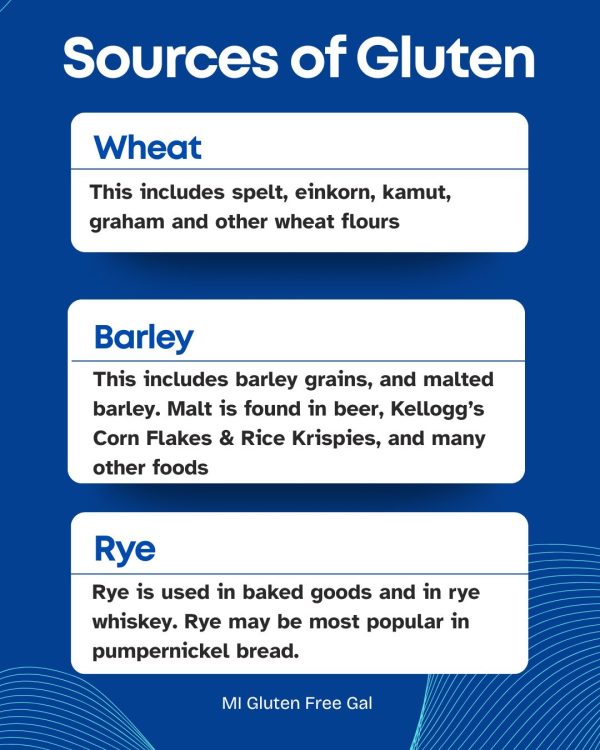
Unlike a wheat allergy, someone with Celiac Disease must look for the 3 different grains that contain the gluten protein which triggers an autoimmune reaction in our bodies. These include:
- Wheat
- This includes spelt, einkorn, kamut, graham and other wheat flours. DO NOT let the well intentioned person at the health food store try to tell you sprouted spelt is safe for your gluten free diet. Sprouting grains does not destroy gluten proteins. Neither does fermentation, so stay away from wheat based sourdough
- Rye
- Manufacturers common use rye in bread, beer and whiskey. Food manufacturers doesn’t tend to “hide” rye in their products, as it has a pretty distinctive taste.
- Barley
- Barley grain is used in beer and milled into flour for breads and other foods. Pearl barley can be used in soups instead of rice.
- In the United States, products made with barley malt, malt syrup and malt extract CANNOT be labeled as gluten free, regardless of whether they test under 20 ppm. This is because barley malt undergoes hydrolysis, and at this time, our methods for testing hydrolyzed gluten aren’t perfect.
- The terms “malt extract” or “malt syrup” unqualified should be applied only to products prepared from barley. Keep in mind that other gluten free grains can also undergo the malting process. See more below.
- What about oats?
- Oats are a tricky food. In and of themselves, they do not contain gluten. HOWEVER, they are often grown in fields and/or harvested with the same equipment that processes wheat and barley. Read my blog post about gluten free oats to learn more about on the topic.
What Does “Gluten Free” Mean?
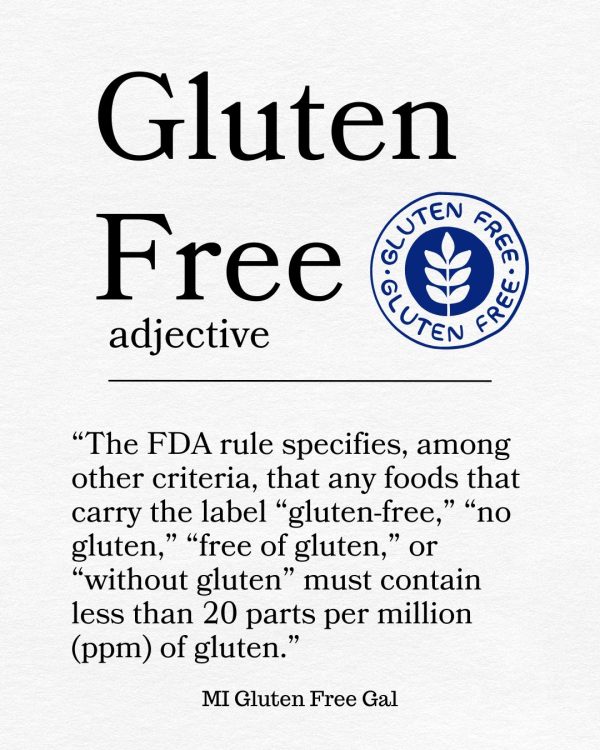
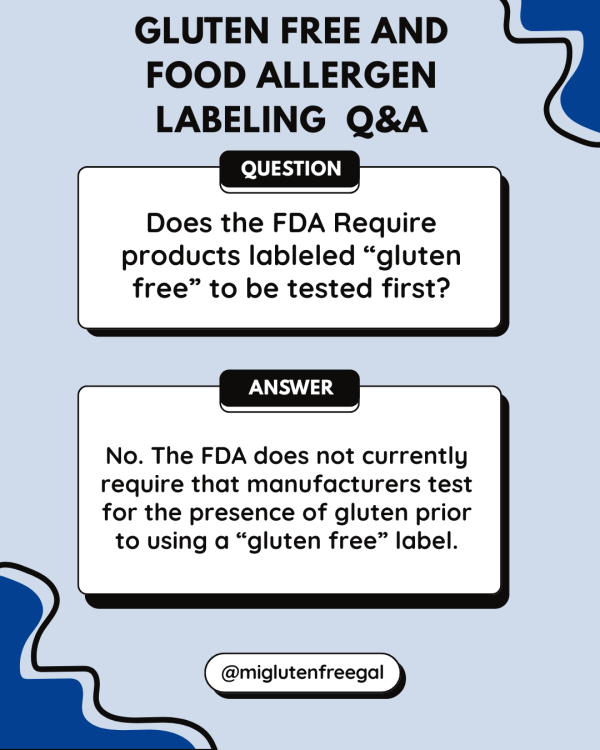
The United States FDA created the definition of “gluten free” in August of 2013. A gluten free claim means that a product must contain less than 20 ppm of gluten protein. Manufacturers can use a gluten free claim WITHOUT prior testing. See more below.
“The rule, which also applies to foods labeled as “no gluten”, “without gluten” and “free of gluten”, sets a strict maximum: products which claim to be gluten-free must contain less than 20 parts per million of gluten. (Allergic Living)
Is Gluten an “Allergen” Under FALCPA?
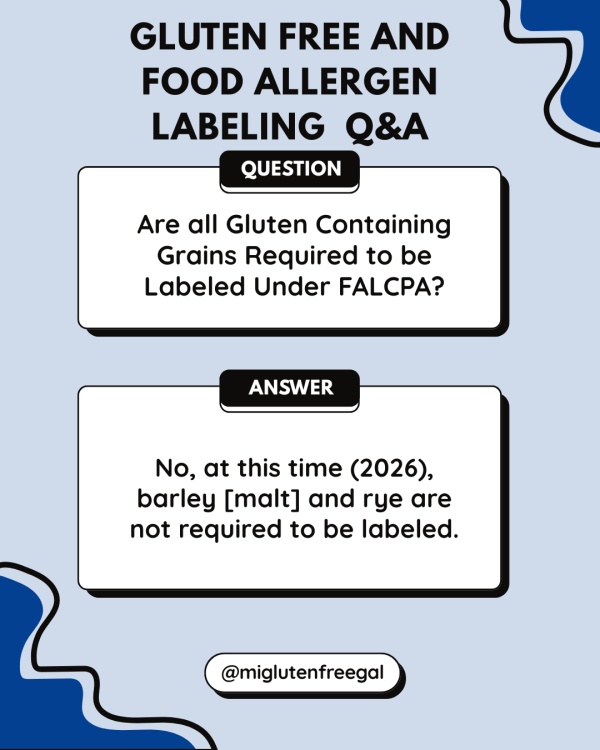
Unlike many other countries, the United States does NOT require the disclosure of all gluten containing grains. At this time, the United States Food Allergen Labeling Consumer Protection Act only requires Wheat to be declared in food labels. No requirements exist for labeling barley or rye.
A note about malt and gluten free labeling rules. Any grain may go through the malting process. In the United States, if the word “malt” exists in an ingredient list, without any additional disclaimers, the FDA says this is malt from barley. If the ingredient list says malted corn, malted sorghum, etc. then the malt in question IS gluten free.
Does the FDA Require Testing Before Using a Gluten Free Claim?
The following statement is found in the United States Guidance for Industry Gluten-Free Labeling of Foods. (PDF) “The (FALCPA) rule DOES NOT require you to test for the presence of gluten in your starting ingredients or finished foods labeled “gluten-free.” (emphasis mine)
“We encourage you to use effective measures to ensure that any foods labeled as “gluten-free” comply with our requirements; such measures may include: •1) testing the ingredients to determine their gluten content; 2) requesting certificates of gluten analysis from ingredient suppliers; or 3) participating in a third-party gluten-free certification program.”
Is Gluten Free Certification Required?
No, United States gluten free labeling rules do not require manufacturers to use third party gluten free certification organizations. There are many gluten free certification organizations, each with different threshold testing requirements. (You can read more about certification in this blog post.)
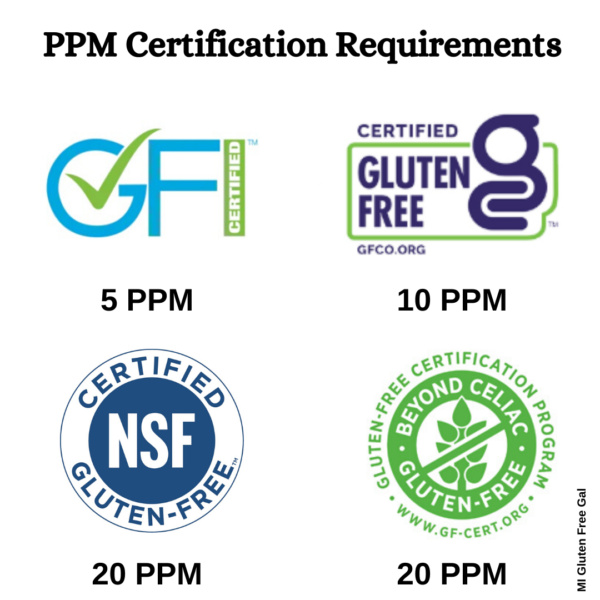
- The Gluten Free Food Program, endorsed by the National Celiac Association, requires products to test under 5 ppm
- The Gluten Free Certification Organization, aka GFCO, (owned by the Gluten Intolerance Group) requires products to test under 10 ppm
- Menu Trinfo has a new gluten free certification program. They require gluten free products to test under 10 ppm.
- The Global Standard Gluten-Free program requires products to test under 20 ppm. It is endorsed by Beyond Celiac in the United States, and the Canadian Celiac Assoc.
- NSF requires gluten free products to test under 20 ppm.
What are the Requirements for Labeling Gluten And Food Allergens in the United States?
Allergens Must Be Plainly Stated in the Ingredient list
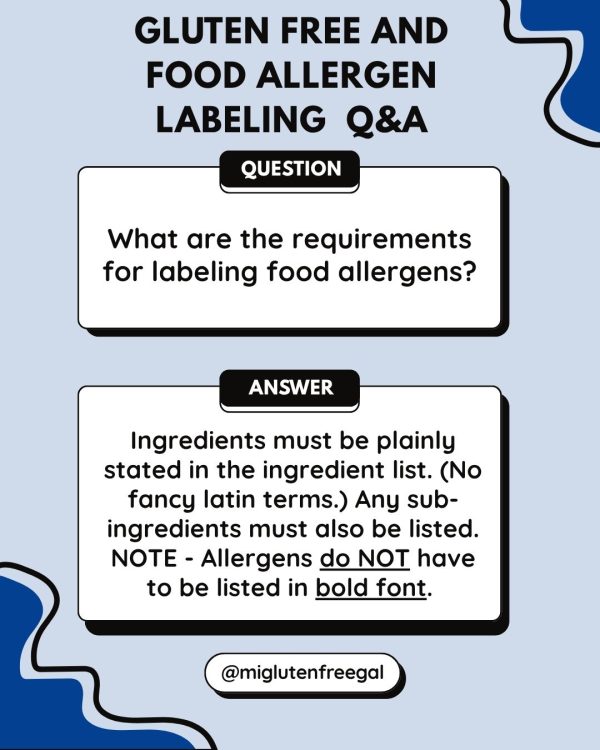
Food allergens must be labeled in plain English. For example, “wheat is a group of wild and domesticated grasses of the genus Triticum.” (Wikipedia) Food producers can’t simply use the term “Triticum’ on a food label. They must use the word wheat.
Sub Ingredients Must Be Listed
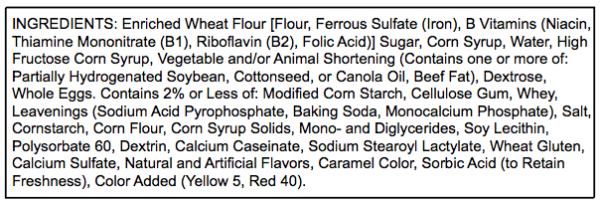
What are sub ingredients? They are ingredients within a larger ingredient. For example, wheat is often an ingredient in soy sauce. If a packaged food contains soy sauce, it must list all the ingredients used to create that soy sauce. Sub ingredients are usually listed within parentheses of a larger ingredient, although not always.
In the example above, the Enriched Wheat Flour includes the added vitamins in brackets.
Do Allergens Need to Be Bolded in an Ingredient List?
No, gluten free and food allergen labeling rules do NOT require allergens to be printed in bold lettering. The sole requirement for food allergen labeling is that that all ingredients must be listed in either the ingredients list or Contains statement. If a Contains statement is used, all major allergens must be declared even if declared in the ingredients list. See more about this below.
A Note about “Contains” Statements
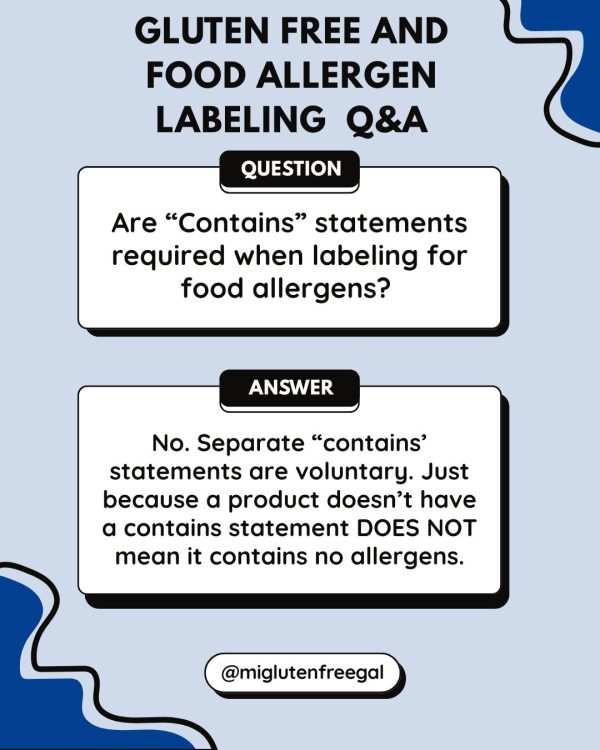
“Contains” Statements Are Not Required
Some companies may include a CONTAINS statement at the end of an ingredient list to highlight food allergens in their product. This is often very helpful. However, is it not required. Do not assume that just because wheat is not highlighted in a contains statement that the product is gluten free.
The One Important Caveat of Contains Statements
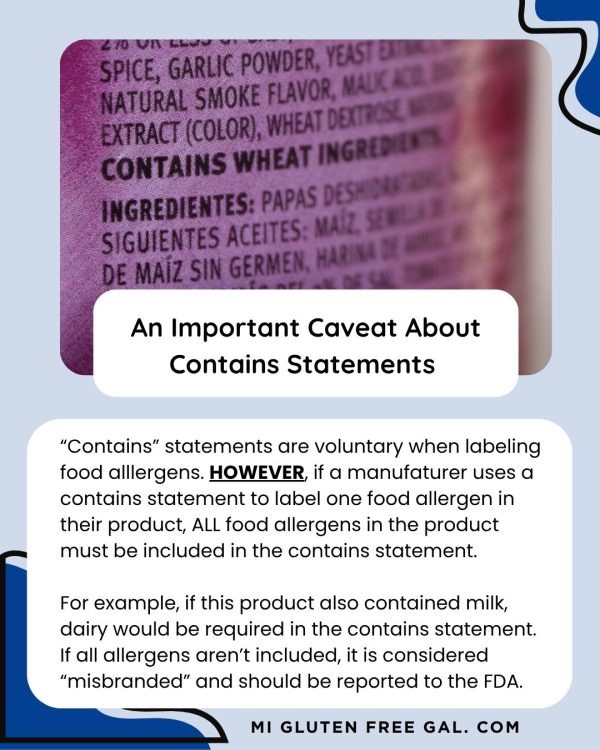
If a company chooses to include a “Contains” statement at the end of the ingredient list, they must list ALL food allergens contained in the product.
For example, if a chocolate bar contains tree nuts and milk, and they choose to use a contains statement, both the milk and the tree nuts have to be included in the “Contains” statement. If they only included the milk in the contains statement, but left out the tree nuts, that product would be considered to be misbranded and should be reported to the FDA.
What about “May Contain” Statements?
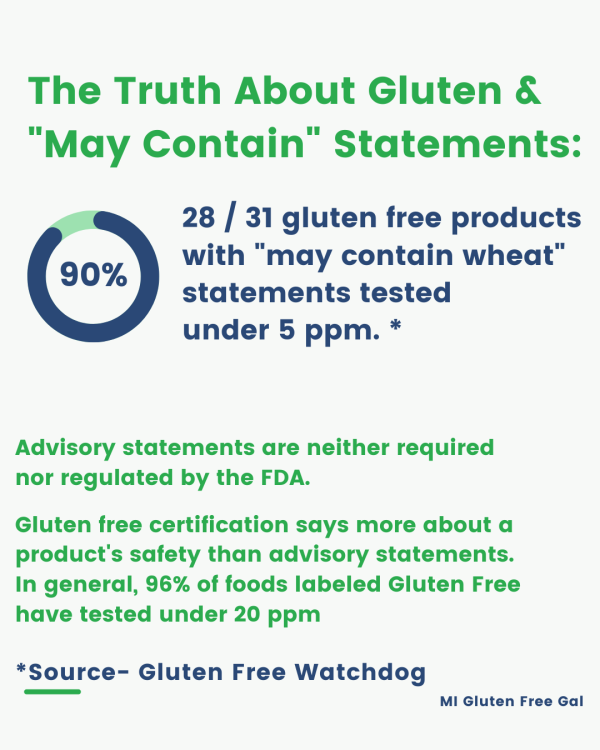
“May Contains” statements are neither required nor regulated by the FDA. In fact, they tend to cause more confusion than comfort. Gluten Free Watchdog has tested multiple products with “may contain” statements and many have tested under 20 ppm.
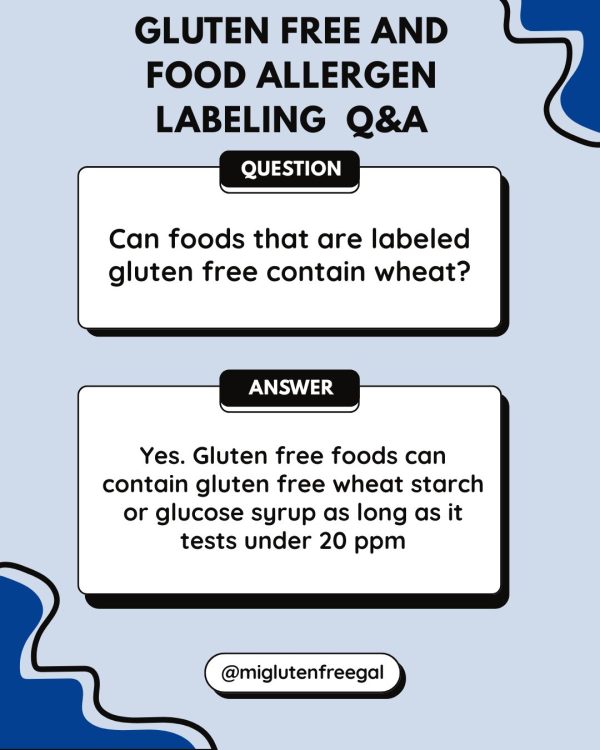
Can something be labeled gluten free and contain wheat?
What I am about to say is very important for those who have a wheat allergy, NOT Celiac Disease. Per United States Gluten Free and Food Allergen Labeling Rules, products labeled gluten free CAN contain sources of highly refined wheat starch.
Companies outside the United States (mostly Europe) have used gluten free wheat starch in their flours and baked goods for many years. An example is the popular Caputo Fioreglut flour blend.
Some companies in the United States are now integrating some of these same practices. These brands include Schar [Croissants and Pain au Chocolat], King Arthur Baking [Gluten Free Pizza Flour and Gluten Free Bread Flour] and Capello’s [New Dinner Rolls and Pizzas.]
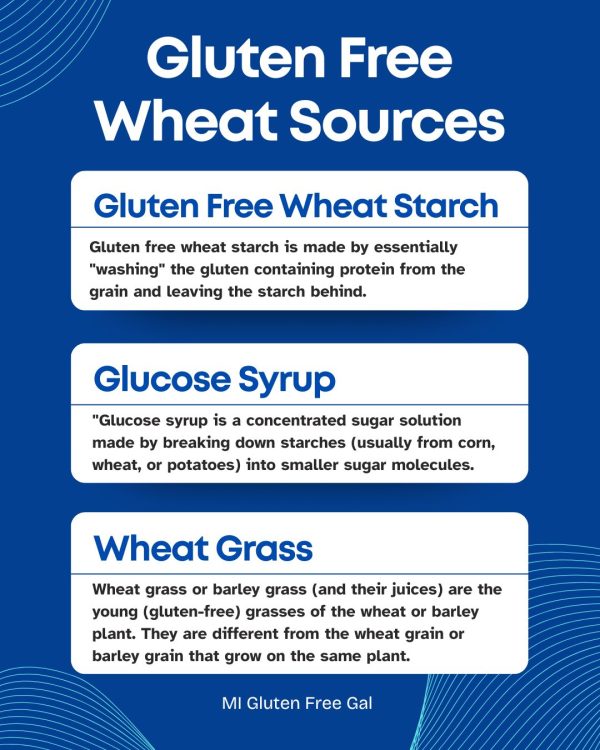
Gluten Free “Wheat” sources
- Gluten Free Wheat Starch
- Gluten free wheat starch is made by essentially “washing” the gluten containing protein from the grain and leaving the starch behind.
- Glucose Syrup
- “Glucose syrup is a concentrated sugar solution made by breaking down starches (usually from corn, wheat, or potatoes) into smaller sugar molecules. This process creates a thick, sweet syrup. ” Quote from Pastry Class
- “The production of glucose syrup involves treating starches with water and enzymes. Enzymes are natural substances that speed up chemical reactions. In this case, they break down the long chains of starch into smaller sugar units, resulting in the syrupy liquid.” Quote from Pastry Class
- “Glucose syrup is considered safe even when derived from wheat, barley or rye. That is because the process used to produce glucose syrup renders the starting material to contain less than 20 parts per million of gluten.” National Celiac Assoc.
- Wheat Grass
- From the National Celiac Association – Wheat grass or barley grass (and their juices) are the young (gluten-free) grasses of the wheat or barley plant. They are different from the wheat grain or barley grain that grow on the same plant and DO contain gluten.”
- “The Food and Drug Administration will allow wheat or barley grass as an ingredient in a labeled gluten-free product, including supplements, as long as the final product contains <20 parts per million (ppm) gluten”
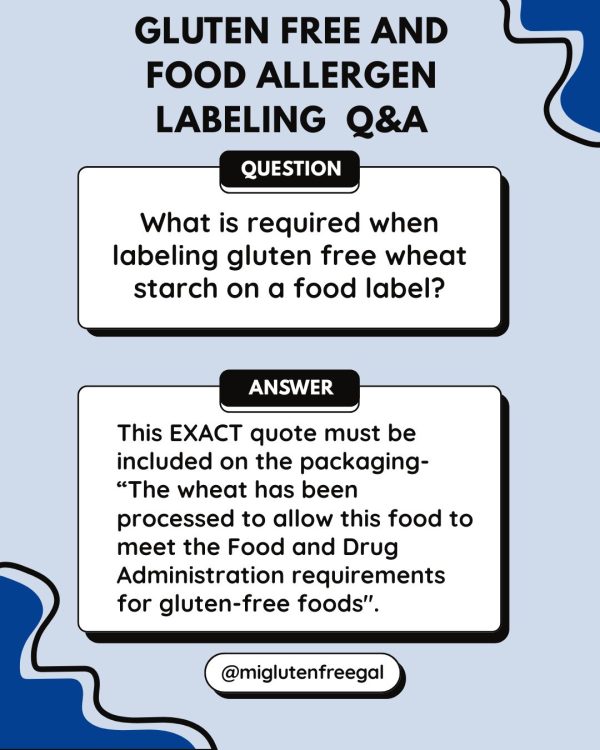
FDA Labeling Requirements of Wheat in Gluten Free Products
If a packaged food that is labeled gluten free contains wheat starch, it is required to include an asterisk and the following statement: “The wheat has been processed to allow this food to meet the Food and Drug Administration requirements for gluten-free foods“. Read the quote below from the FDA regulations on gluten free labeling of food to learn more.
A food that bears the term “wheat” in the ingredient list or in a separate “Contains wheat” statement in its labeling, as required by 21 U.S.C. 343(w)(1)(A), and also bears the claim “gluten-free” or a claim identified in paragraph (b)(2) of this section will be deemed misbranded unless the word “wheat” in the ingredient list or in the “Contains wheat” statement is followed immediately by an asterisk (or other symbol) that refers to another asterisk (or other symbol) in close proximity to the ingredient statement that immediately precedes the following: “The wheat has been processed to allow this food to meet the Food and Drug Administration (FDA) requirements for gluten-free foods.”
Wheat Protein vs Starch
Wheat grains contains protein and starch. People with Celiac Disease experience an autoimmune reaction to the PROTEIN in wheat, not the starch. This is why highly refined wheat starch can be labeled gluten free.
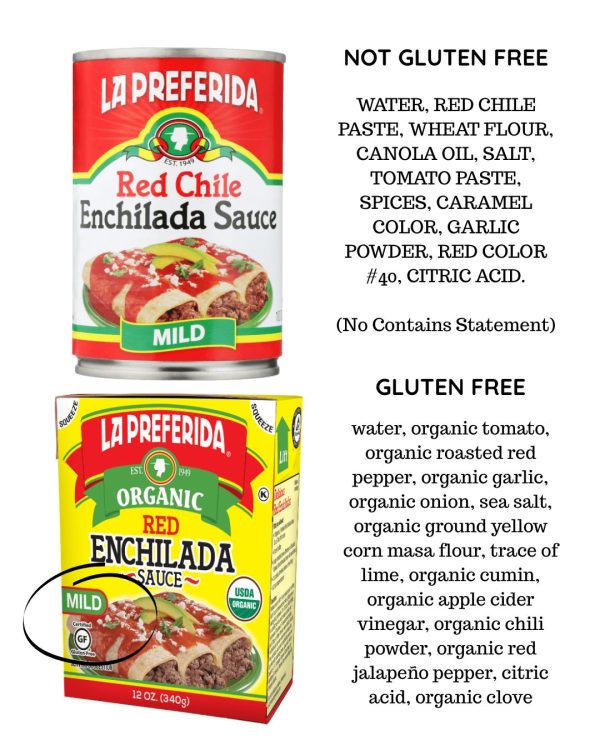
This Family’s Story Highlights the Need for Better Gluten Free and Food Allergen Labeling Rules
Hi, I’ve followed you for years. My son, he’s almost 9 now, but was diagnosed with an anaphylactic wheat allergy at 10 months. Over those years we’ve had one exposure at day care and one at a restaurant. Last night though, was the first time we had an issue at home that resulted in a hospital visit (he’s good now).
I’m reaching out to you because you’re more active / knowledgeable in the gluten space than I am. What happened was we made enchiladas and the sauce (La Preferida red Chile enchilada sauce) doesn’t have the warning ‘Contains: Wheat’ but looking closer at the ingredients it contains ‘Wheat Flour’.
I’ve used this sauce before, but, I must’ve had the organic variant which is certified GF. Tough lesson but I’m trying to understand how something can contain ‘Wheat Flour’ and not have the warning.
What Else Do You Need To Know About Eating a Gluten Free Diet?
I do want to make sure to say this – IT DOES GET EASIER. If you recently received a Celiac Disease diagnosis, this can be very overwhelming. Trust me when I say you will find your new normal, and it will be all right.
In addition, many people on the internet make a living by making you scared and afraid. Be careful about which voices you listen to. I trust these USA bloggers to give factual info.
We can control what happens in our own kitchens. When we eat out, we need to ask more questions. (Luckily, I have a handy guide for that!) If you live in Michigan, check out my list of restaurants with great gluten free options that I recommend. It includes a sub list of Michigan restaurants that maintain a 100% gluten free kitchen.
Have any additional questions? Drop me a message in the comment section below! Did you find this post to be incredibly helpful? Please share it with others who need it. 🙂
Sincerely,
Margaret Clegg aka MI Gluten Free Gal